
If you’ve ever tried to teach students that words have meanings (yes, really), you’ve probably had to explain the difference between connotation and denotation. Spoiler: this is one of those ELA lessons where teenagers suddenly become philosophers—“But technically, doesn’t ‘fire’ also mean passion? So if I call my dog ‘fire,’ am I wrong?” Deep sigh. Long sip of coffee.
Let’s break it down anyway, because apparently dictionaries aren’t enough:
Denotation = the dictionary definition. Cold. Hard. Sterile. (Like the fluorescent lights in your classroom.)
Connotation = the emotional baggage the word drags around with it. Sometimes glamorous, sometimes tragic, sometimes the verbal equivalent of that one student who insists literally can mean figuratively.
So when you compare ‘slim,’ ‘skinny,’ and ‘svelte,’ they technically all point to the same denotation: “not carrying extra weight.” But the connotations? Slim is polite. Skinny is judgy. Svelte is vogue. Same base meaning, wildly different vibes. Welcome to ELA.
—
Connotation and Denotation Examples (a.k.a. Student Headaches)
Want connotation vs denotation examples that go beyond the tired “house vs. home”? Here’s a taste:
Cheap / Affordable / Economical
Childish / Youthful / Innocent
Nosy / Curious / Inquisitive
See how the denotation stays the same, but the connotation swings from insult to compliment faster than your principal can say, “Data-driven instruction”?
—
Teaching Connotation and Denotation Without Losing Your Sanity
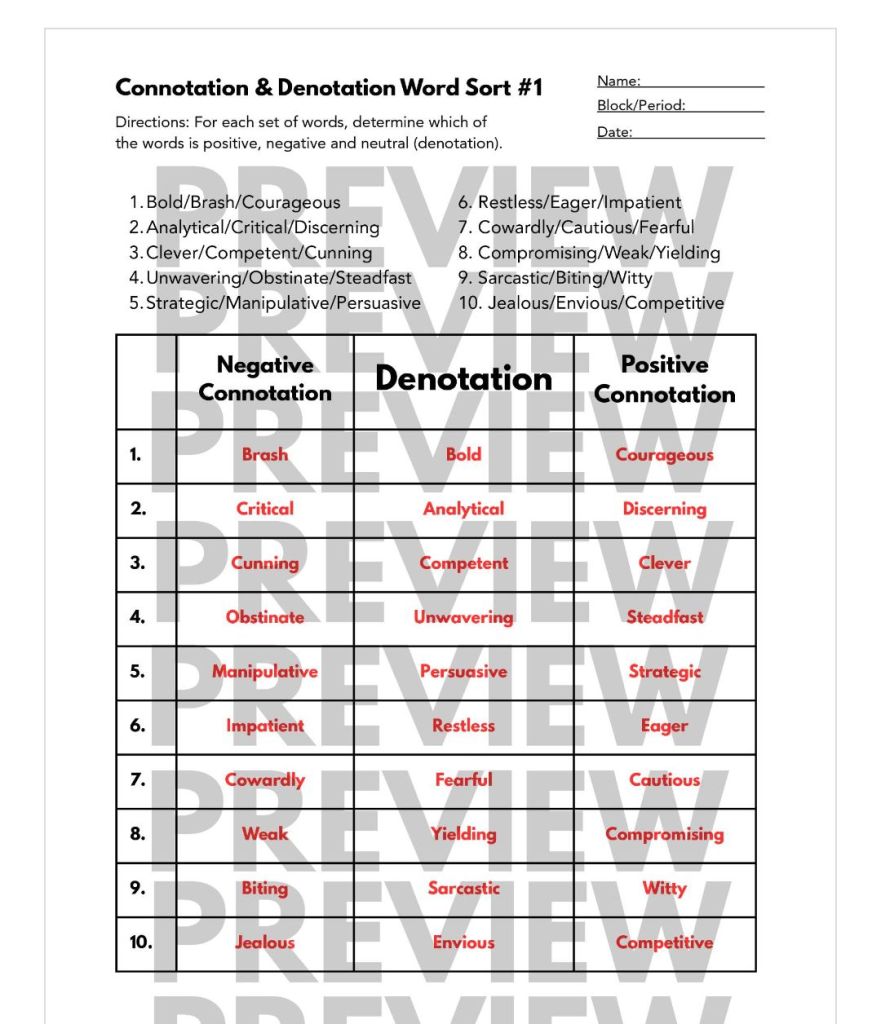
I put together a resource that does the heavy lifting for you:
Connotation vs. Denotation Handouts (Teachers Pay Teachers)

It includes:
-5 handouts with 10 sets of words each (that’s 150 words, but who’s counting… besides your students).
-A task that requires sorting into positive connotation, negative connotation, and denotation—because nothing says “fun Friday” like word classification.
-A student glossary (AKA differentiated handout) for students with limited vocabulary, so no one gets left behind when everyone else is arguing over whether “eccentric” is charming or creepy.

Flexible use: these handouts can double as bellringers for quick practice or expand into a week-long mini-unit if you’d like to dig deeper.
I’ve even included a detailed teacher’s guide for easy whole-group review and/or small-group instruction.

—
Final Thought
Words are slippery little things. Denotation is the meaning you’d get if you Googled it; connotation is the meaning your students will argue about until you beg them to stop. Together, they explain why calling someone ‘thrifty’ feels like a compliment, but calling them ‘cheap’ might earn you a death glare.
Save yourself the headache—teach it once, teach it well, and let the handouts do the heavy lifting.
 Well-Versed ELA